

- From
- Rs. 24,999*
- Nights
- 6
- Open dates
- 6
Field guide · Meghalaya
Shillong travel guide
Meghalaya's hill capital: pine-covered slopes, a lake from 1894, loud markets, live music most nights and the best Khasi food stalls in the state.
- About 1,500 mAltitude
- About 100 km, 3 hoursFrom Guwahati
- One or two nightsGood for
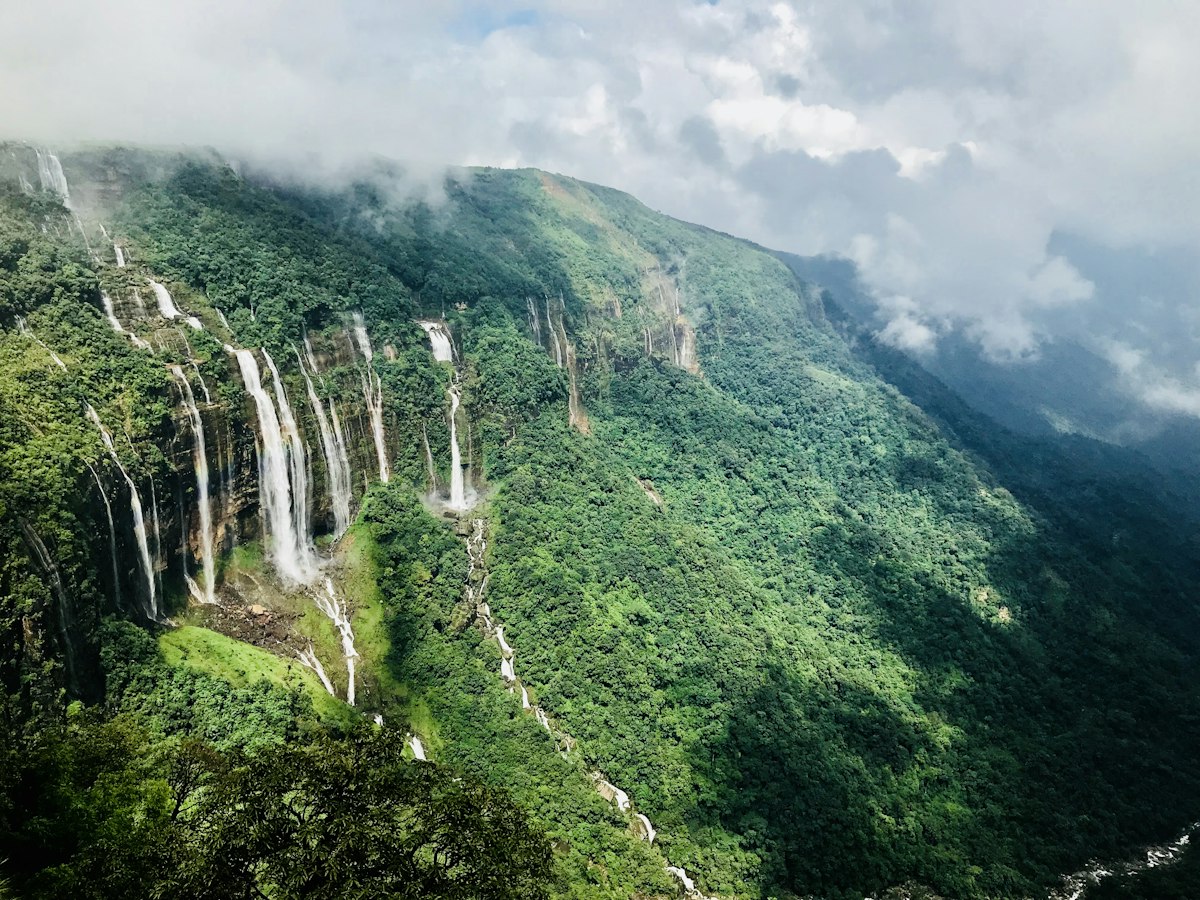
Photo: Streams of water running down a green cliff face into a cloud-filled valley in the Khasi Hills near Shillong
Shillong takes its name from Lei Shyllong, the deity of the peak above the city. The British made it a civil station in 1864 and the capital of Assam ten years later, and for almost a century the whole north-east was run from here. It became the capital of Meghalaya when the state was created in 1972.
Most travellers treat it as a place to change vehicles between Guwahati and Cherrapunji. It deserves a day and an evening of its own.
Overview
A capital that kept its hills
The city is spread over hills at roughly 1,500 m, with Shillong Peak above it at about 1,965 m. The colonial town was wrecked by the great earthquake of 12 June 1897 and rebuilt in the light timber-frame style you still see in older houses.
Police Bazaar, named after a colonial police outpost, is the commercial centre. Laitumkhrah is the student quarter, with cafes and bakeries. Bara Bazaar, or Iewduh, is the huge traditional market, run largely by Khasi women.
The music
Shillong calls itself India's rock capital, and it has earned it. Western music arrived with missionaries and schools, and the city has had working bands since the 1960s. Several cafes host live sets through the week.
Traffic
The one thing everyone complains about. Roads are narrow and jams are long, especially in the evening and around Police Bazaar. Stay within walking distance of where you want to eat.

Things to do
A day and an evening
-
Ward's Lake
A horseshoe lake in a garden, built in 1894 to a plan by the Chief Commissioner Sir William Ward. Locals call it Nan Polok. A footbridge crosses the middle, and there are paddle boats.
-
Don Bosco Centre for Indigenous Cultures
Seven floors and 17 galleries on the peoples of north-east India, opened in 2003, with a skywalk on the roof. The best single introduction to the region. Published hours are 9:30 to 5:30, Tuesday to Saturday, so check before you go.
-
Police Bazaar and Bara Bazaar
Police Bazaar for street food and shops. Bara Bazaar, a short walk on, for the real market: betel nut, dried fish, bamboo baskets, knives, vegetables you will not recognise. Go in the morning and keep your bag in front.
-
Laitlum canyons
A ridge above a deep valley near Smit. A stepped path leads down the escarpment for those who want more than the view. Cloud often fills the valley by mid-morning.

Laitlum before the cloud comes in -
Elephant Falls
A three-step waterfall, which is what its Khasi name means, with stairs down each level. Easy, popular and at its best just after the rains.
-
Mawphlang sacred forest
A grove protected for centuries by Khasi religious custom, where nothing, not a leaf, may be taken out. You enter with a local guide who explains the plants and the monoliths. One of the most worthwhile half-days near Shillong.
-
Live music after dark
Ask your host who is playing tonight. On most evenings somewhere has a band.
Practical info
Before you go
Best time
October to May
October to February is dry and cool, with cold nights in December and January. March to May is mild with showers. June to September is the monsoon: green, wet and often foggy.
Getting there
From Guwahati
About 100 km and three hours by road from Guwahati, which has the nearest major airport and railway station. Shared taxis and buses run all day. Shillong's own airport at Umroi has limited flights.
Getting around
Shared black-and-yellow taxis
Local taxis run fixed routes and take several passengers. Tell the driver where you are going before you get in. For day trips, hire a car through your hotel. Guides note that the state banned self-drive rentals to tourists in June 2025, so check the current rule if you planned to ride.
Altitude
Comfortable
At about 1,500 m, altitude is not an issue. Bring a jacket for the evening.
Sundays
Things close
Meghalaya is largely Christian and Sunday is quiet. Many shops and some restaurants close, and markets are thin. Plan a day trip instead.
Build your packing list
Shillong is cool, not cold, and often wet. Tell the builder the month.
Open the Packing List BuilderGo with Charkadam
Shillong, with a group
Shillong is on both of our Meghalaya trips. The trip pages have the day-by-day plans.
* Indicative starting price. The trip page shows the price for each date.
- From
- Rs. 27,999*
- Nights
- 10
- Open dates
- 6
Questions
Shillong, answered
One full day and an evening covers the lake, a market, the Don Bosco museum and dinner with music. A second day lets you add Laitlum and the Mawphlang sacred forest.
About 100 km by road, which takes around three hours depending on traffic.
Its hill-station setting, its music scene, colonial-era landmarks such as Ward's Lake, and Khasi food. It is also the gateway to Cherrapunji, Dawki and the rest of Meghalaya.
October to May. The monsoon months from June to September are very wet.
Keep reading
Guides nearby
-
 The whole state
Meghalaya
Root bridges, caves, waterfalls, Khasi food and how the seasons change all of it.
The whole state
Meghalaya
Root bridges, caves, waterfalls, Khasi food and how the seasons change all of it.
-
Falls, caves, root bridges
Cherrapunji (Sohra)
Nohkalikai, the steps to Nongriat, and the caves under the plateau.
-
 The clear river
Dawki and Shnongpdeng
When the Umngot is glass, when it is mud, and which village to pick.
The clear river
Dawki and Shnongpdeng
When the Umngot is glass, when it is mud, and which village to pick.
-
 Monastery town near the border
Tawang
India's largest monastery, high lakes, Monpa food, and the permits you need.
Monastery town near the border
Tawang
India's largest monastery, high lakes, Monpa food, and the permits you need.


